
Concrete Lifting, Foundation Repair, and Waterproofing.
Lifted in a day.
Guaranteed for years.
Polyflow raises sunken driveways, patios, and floors with polyurethane foam. We test the soil before we quote, and most jobs finish the same day.
5 to 25 yrWarranties by service
FreeOn-site estimates
Same DayBack on your driveway
TestedSoil assessed before we quote
Our services
One clear path to the right repair
Foundation lifting & Repair
Leak Seal & Water Stop
Crack Repair and Joint Sealant
Increase the load bearing capacity of deep soil
What we fix
Problems we repair and what causes them
Settled slabs, moving foundations, and water damage can have different causes. We assess drainage and soil compaction to identify the right repair, rather than treating only the visible damage.
Driveways & Walkways
Sunken panels, trip hazards, and slabs that dropped at the seams, raised back to grade.
Garage & Shop Floors
Interior slabs lifted through small ports drilled in the surface. No demolition, no replacement.
Foundation Settlement
Stair step cracks, sticking doors, and out of level floors, corrected with piers, jacks, or deep injection.
Cracks, Joints & Voids
Washed out soil filled and joints sealed so water stops undermining the slab.
Why it happens
Why concrete settles in the Treasure Valley
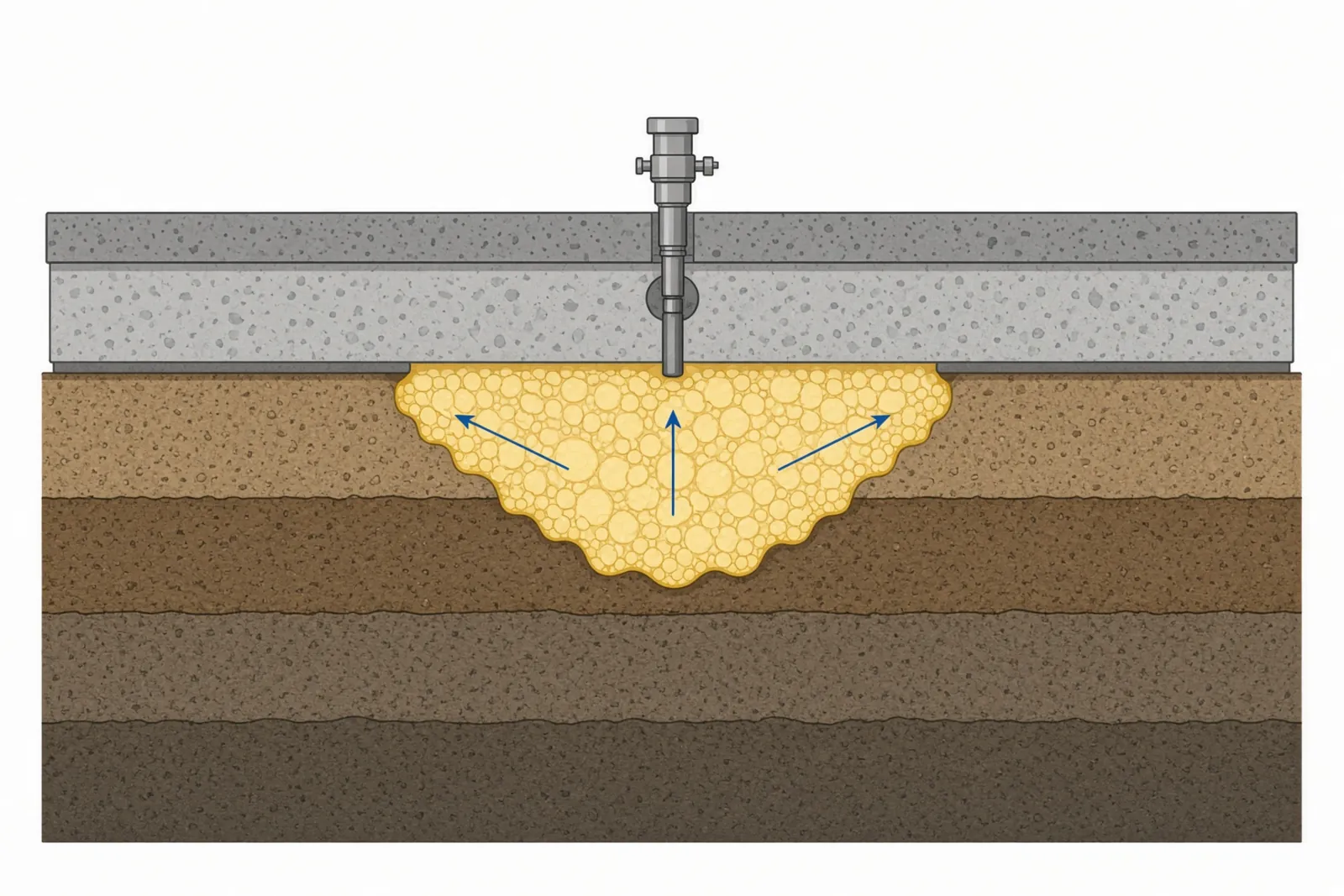
Concrete almost never fails on its own. It fails because the soil underneath moves, and soil in this valley moves for reasons specific to where we live.
Irrigation and canal water
The valley is threaded with canals, laterals, and drains. Seasonal wetting and drying moves fine material through the sub base, and leaks wash out support under nearby slabs. Properties on flood irrigation settle differently than properties on city water.
Fill that was never fully compacted
When a lot gets graded and backfilled quickly, compaction can come up short. The shortfall does not show until a few years of load and moisture cycling have compressed the fill, which is why newer subdivisions produce as many calls as older neighborhoods.
Silt soils that lose strength when wet
Much of the valley sits on wind deposited silt with low cohesion once saturated. A downspout dumping at a foundation corner or a leaking sprinkler line is enough to drop bearing capacity in one spot. That is the single sunken panel most homeowners notice first.
Freeze and thaw cycling
Our winters cycle in and out of freezing rather than staying frozen. Each cycle expands and contracts moisture in the sub base and in existing cracks, widening joints and loosening support a little more each year.
Erosion around water structures
Dams, cisterns, headgates, retaining walls, and stem walls in contact with moving water lose backfill steadily. By the time a void shows at the surface it is usually larger underneath.
How it works
Five clear stages
1.
Test
We test the site and the support.
2.
Estimate
We explain the repair and price.
3.
Approve
You approve the scope.
4.
Complete
Polyflow completes the service.
5.
Warranty
Your service term is clear.
Customer reviews
What homeowners say
“Great job fixed my issues and more. The guys were very helpful. Will make sure others know this can be done”
“Very professional, detail-oriented, meticulous and reliable. Polyflow is one of the rare, very reliable contractors in Treasure Valley. Can't recommend them highly enough.”
“Pat and Cade were awesome. I have a colored and stamped concrete border around my patio that had sunk significantly over time. They used their innovative concrete lift to jack up the slab and then injected foam under pressure to support it. Very happy with results. To boot, these are just very enjoyable guys who do what they say they will do, when they say they will do it. Highly recommended.”
“Patrick and his Team arrived on schedule and performed our concrete lift flawlessly. The job was completed quickly, cleanly and professionally. They are amazingly smooth and a real art to watch as they work. It was a pleasure to work with Polyflow from our initial inquiry all the way through the completed work.”
“I would highly recommend Polyflow. Patrick did a great job of explaining the process and followed through with a great product. They showed up on time and perform their work quickly, when they were done they cleaned up the job site.”
Project experience
Real work across the valley
Complex Foundation Repairs
A newly developed neighborhood was built on 12 feet to 35 feet of fill material. Over the course of the first few years homeowners experienced differential foundation settlem…
Read the projectResidential Compaction Testing with a Handheld Probe
Many concrete leveling quotes are based on a quick visual inspection, a few measurements, and assumptions about the cause. In reality, settlement can be driven by deep soil i…
Read the projectFlowable Grout vs High Density Structural Foam
In foundation lifting projects using helical or push piers, a void often remains between the footing and the ground after elevation is restored. If that gap is not properly f…
Read the projectFind out what is under your slab
Estimates are free and done on site. We test the soil before we quote, so the price reflects the actual problem.