Cracks in your foundation
Some cracks are normal, but others are not and are the first sign your foundation is moving.

A settled foundation needs the right support. Erosion, inadequate soil compaction, and decomposing organic material can cause settlement. We assess the cause and severity on site. Options to lift and stabilize the foundation include resistance piers, helical piers, and deep injection of high-density, structural-grade polyurethane foam.
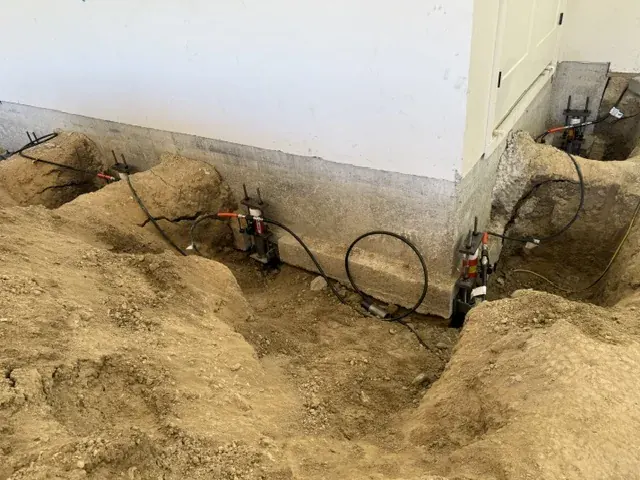
Some cracks are normal, but others are not and are the first sign your foundation is moving.
Cracks follow mortar joints, widen over time, or appear with separation around brick or siding.
Openings that once worked normally begin sticking, rubbing, or showing uneven gaps as the surrounding frame changes shape.
Floors visibly dip, furniture leans, or an assessment of floor elevations shows that part of the structure has moved.
A porch, footing, or wall has dropped or separated from the main structure, suggesting movement below the supported area.
Visible cracks in walls or ceilings, especially new or widening ones, are worth checking alongside other signs. A crack alone does not mean the foundation is moving.
Call to schedule an uplifting onsite inspection.
Thorough inspection to confirm it is a foundation or structural issue.
Geotechnical report of soil conditions or Polyflow penetrometer compaction test.
Polyflow estimate.
Client approves initial estimate.
Stamped Structural Engineer Plans.
Revise estimate according to stamped plans.
Client approves stamped plans.
Polyflow completes the work.
25 year warranty on all structural repair fixtures.
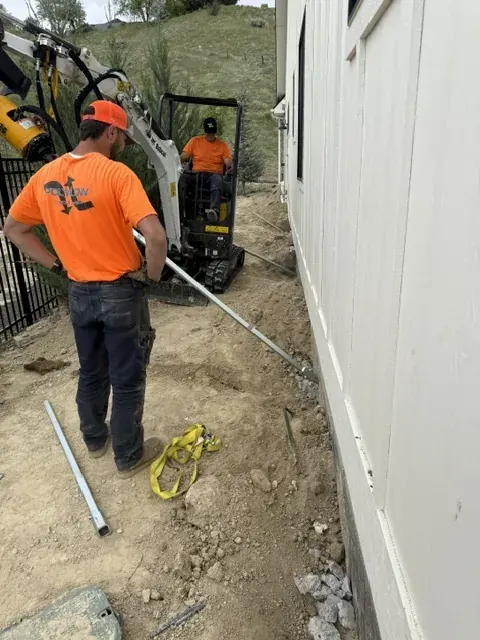
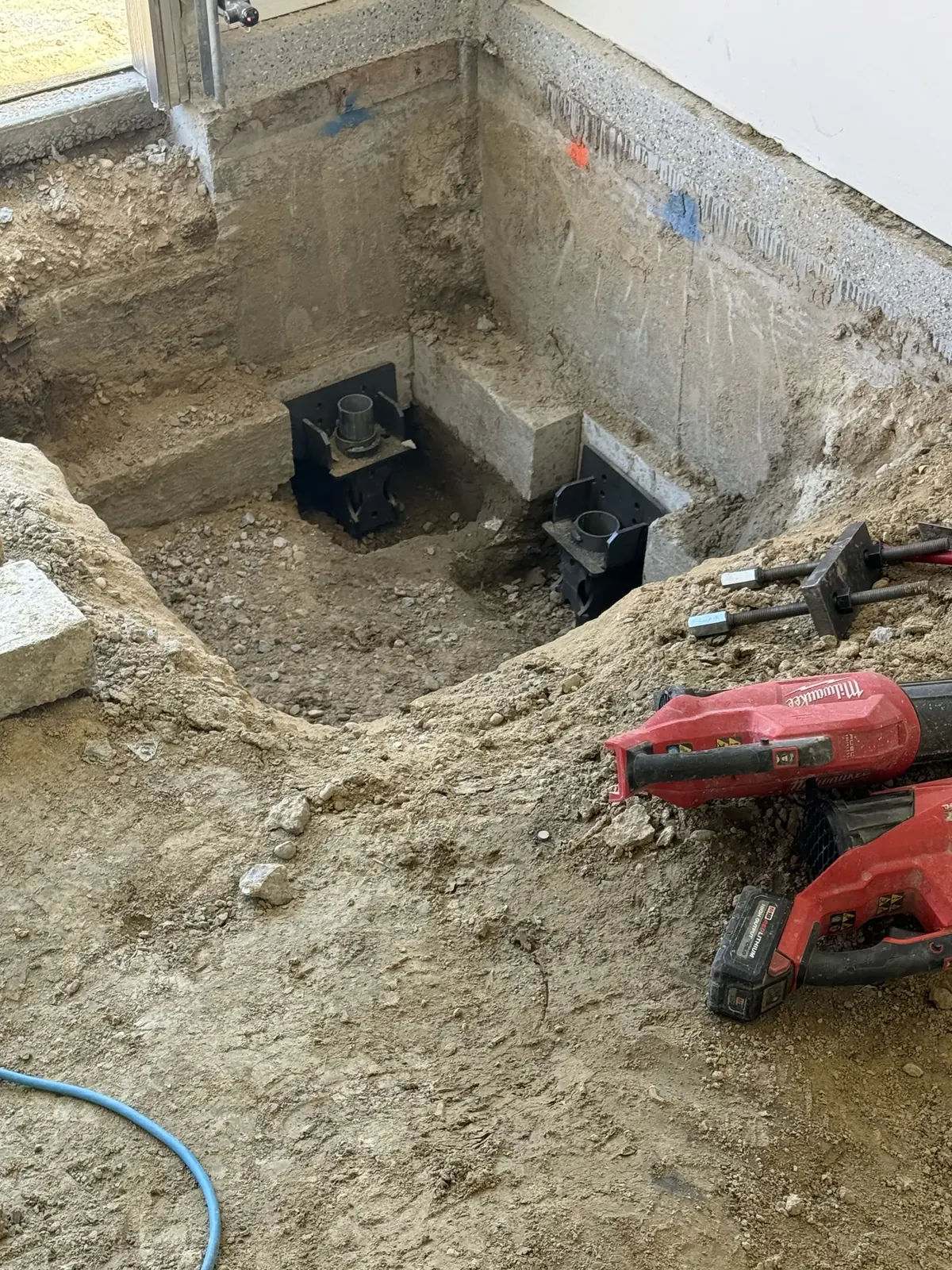
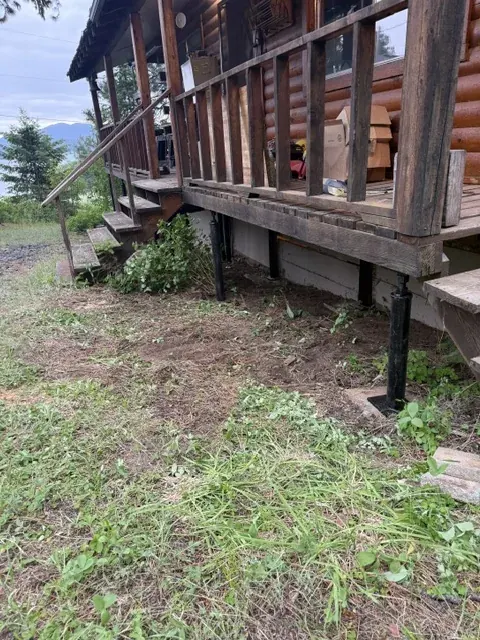
We don't believe getting warranty work taken care of should ever be a hassle.
If you have a concern with work we've completed, simply give us a call. We're always happy to come back out and take a look. Warranty calls are a priority for us, and we'll make every effort to get back to you as quickly as possible.
We take pride in standing behind our work. In fact, there have even been times when we've stepped in and covered warranty work for a competitor's customers. Either because they weren't sure who originally did the work or because the original contractor didn't honor their warranty.
That's the kind of company we want to be. We enjoy serving our customers, and we're always happy to return and make sure the job is taken care of right. You shouldn't have to worry about whether calling us back is going to be a hassle. If you need us, just give us a call. We'll be there.
25 year warranty on all structural repair fixtures
A Horseshoe Bend home had settled about one inch at the front. Polyflow traced the movement to roof runoff, then used brackets, push piers, synchronized jacking, and restored elevation.
Polyflow work documented for foundation repair.
A newly developed neighborhood was built on 12 feet to 35 feet of fill material. Over the course of the first few years homeowners experienced differential foundation settlem…
Read the projectIn foundation lifting projects using helical or push piers, a void often remains between the footing and the ground after elevation is restored. If that gap is not properly f…
Read the projectThese apartments have a common covered front porch that is supported by structural 4×4 wooden posts, which are surrounded by a decorative siding. Each individual post sits on…
Read the projectA durable repair starts with the right diagnosis. Use these answers to understand the options, compare proposals, and know what a site-specific evaluation still needs to determine.
A crack alone does not identify the cause. Width, direction, location, displacement, moisture, and changes over time all matter, as do sticking doors, sloping floors, separated trim, and gaps at windows. Some cracks result from normal material shrinkage; others accompany soil movement, drainage problems, settlement, or structural loading. A useful diagnosis typically combines a visual inspection, an assessment of floor elevations, site and drainage observations, and a review of when symptoms appeared. Monitoring may be appropriate when evidence is inconclusive. Polyflow evaluates the visible conditions and may coordinate with a structural or geotechnical engineer when independent analysis is needed. Homeowners should be cautious of any recommendation based only on a photograph or a single crack without considering the building and site as a whole.
Each method addresses a different condition, so none is a universal foundation fix. Push or helical piers may be considered when loads need to be transferred to more competent material at depth, but access, structure weight, soil profile, and bracket locations affect suitability. Adjustable jacks may support and level certain crawlspace framing when the underlying support and load path are properly evaluated. Deep injection may be appropriate for some soil or void-related conditions, depending on the material, depth, and repair objective. These methods may be a poor fit when the observed damage is only cosmetic, movement is not established, drainage is the primary unresolved cause, or the structure cannot accept the proposed installation. Polyflow selects among these approaches based on site findings and seeks engineering input when warranted.
The process should begin with the history of the home and symptoms: when cracks appeared, whether they changed, prior repairs, water patterns, and any remodeling that altered loads. A site evaluation may include foundation and framing observations, relative floor-elevation readings, drainage review, and inspection of accessible crawlspace or basement areas. Polyflow then relates the evidence to possible causes and explains whether monitoring, maintenance, engineering review, or repair appears appropriate. If piers, jacks, or injection are considered, the plan should identify the intended support areas and the objective of each element. Conditions that cannot be confirmed visually may require further investigation. Engineering documents, utility locating, access planning, and permits should be addressed before work when applicable, rather than treated as assumptions after installation begins.
The right comparison depends on the diagnosed problem. If movement is unconfirmed, documented monitoring may provide better information than immediate structural work. If surface water, leaking drainage, expansive soil moisture changes, or erosion is contributing, grading, gutters, downspout discharge, plumbing repair, or site drainage work may be part of the solution. Localized framing damage may call for carpentry or support repairs rather than underpinning. Some conditions require conventional excavation, footing repair, wall reinforcement, or replacement of damaged materials. Cosmetic crack sealing can improve appearance or limit water entry but does not stabilize active movement. Polyflow can explain why its proposed method matches the observed condition, but homeowners should also ask whether a less invasive option, staged approach, or independent engineering evaluation would answer the same need.
Not necessarily. Stabilization and lifting are different objectives. Stabilization aims to reduce further movement by improving support; lifting attempts to recover some lost elevation. A structure may not be safely or predictably returned to its original position because finishes, framing, utilities, additions, and long-settled components can resist movement or be damaged by it. Even when adjustment is attempted, cracks may remain, doors may still need carpentry adjustment, and floors may retain some slope. Polyflow should state the proposed objective before work and explain where adjustment will be attempted, limited, or avoided. Masonry, drywall, tile, plumbing, and other finishes may need separate repairs after the foundation work. Homeowners should not interpret a structural repair plan as a promise of complete cosmetic restoration.
All of the hardware for the piers has a 25 year warranty. Durability also depends on correct diagnosis, design, materials, installation, soil conditions, corrosion exposure, load transfer, and continued control of water around the home. Deep foundation elements are intended to transfer support beyond problematic near-surface material, while brackets and connections must continue to carry loads as designed. Adjustable jacks may need periodic observation or adjustment in some applications. Injection performance depends heavily on the target material and whether the underlying mechanism was correctly identified. No method makes the entire property immune to movement elsewhere. New plumbing leaks, erosion, drainage changes, excavation, drought or wet cycles, and alterations to structural loads can affect future performance. Polyflow can describe the components and maintenance expectations for the proposed system; project-specific engineering and written contract terms should govern what is actually being provided.
Disruption varies with access and repair type. Exterior pier work may require localized excavation near the foundation, temporary removal of landscaping or hardscape, and room for equipment and spoil. Interior access can involve flooring, slab openings, dust control, and moving belongings. Crawlspace jacks may be less visible but can require tight-access work and modifications around ducts, plumbing, or insulation. Injection requires access to planned points and may involve drilling and pumping equipment. Utilities should be located, and the contractor should explain protection for drains, irrigation, electrical lines, finishes, and occupied areas. Ask Polyflow for a site-specific sequence, expected work zones, restoration scope, and items the homeowner must move. Landscaping, concrete, flooring, and cosmetic restoration should be clearly identified as included, excluded, or separately priced.
Cost is driven by the repair scope, not simply by the number of visible cracks. Important factors include the diagnosed cause, number and depth of support points, structural loads, pier type, bracket configuration, injection volume and material, crawlspace clearance, excavation difficulty, interior versus exterior access, and obstacles such as decks or concrete. Engineering, geotechnical investigation, surveys, permits, utility work, drainage corrections, and restoration can also affect the total. Unforeseen subsurface conditions may change production or design, so the contract should explain how changes are authorized and priced. Polyflow should provide an itemized scope tied to the repair objective rather than relying on a broad package description. When comparing proposals, verify that each contractor is pricing the same locations, assumptions, access work, testing, restoration, and professional services.
Keep the final plan, photographs, installation records, engineering documents, permit records, and written product or workmanship terms together. Ask for baseline elevation records and other documentation used to assess future change, plus a clear inspection schedule if one is recommended. Maintain gutters, downspouts, grading, drains, and plumbing so water is not concentrated beside or beneath the foundation. Do not immediately hide every crack if the repair team or engineer recommends a monitoring period; dated photographs and notes on changes in elevation or cracks can help document progress. Cosmetic repairs should usually follow guidance on when structural adjustment is complete. Contact Polyflow if new displacement, recurring gaps, unusual floor changes, or water problems appear. Aftercare requirements are project-specific, so follow the written plan rather than assuming every pier, jack, or injection project needs the same maintenance.
Ask what evidence shows active or consequential movement, what cause is most likely, and what information remains uncertain. Request the repair objective in plain language: monitoring, stabilization, lifting, load transfer, soil treatment, or a combination. Ask why the proposed system fits better than alternatives and what it cannot correct. The contract should identify locations, quantities or unit-pricing rules, access, restoration, drainage responsibilities, change-order procedures, and documentation delivered at completion. Also ask whether a structural or geotechnical engineer should design or review the work, who retains that professional, and whether local permits or inspections are required for this specific project. Confirm who will supervise installation and how field conditions are documented. Finally, read exclusions and written warranty terms carefully, including coverage, transferability, maintenance duties, and the process for requesting service.
Estimates are free and done on site. We test the soil before we quote, so the price reflects the actual problem.